
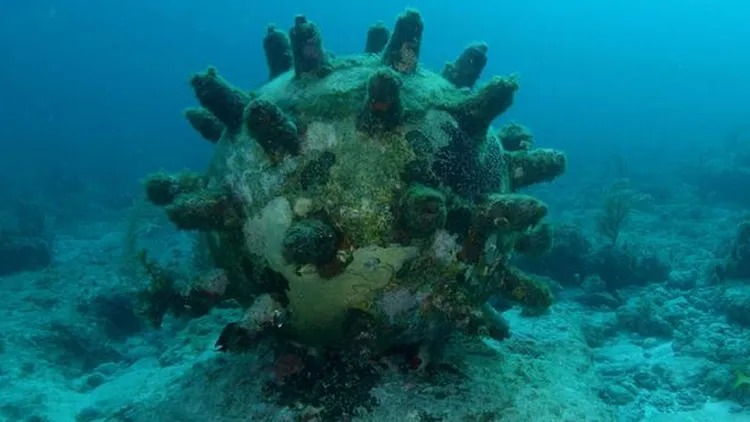
Affordable Tools to Find and Mark Underwater Explosive Ordnance
Reward
$20K
Deadline
April 3, 2026
Time remaining
Organizer
UNDP
Host Organization
Challenge Description
ActiveLanguage: English
BackgroundFollowing conflicts across the world, millions of tonnes of explosives remain underwater in inland, ocean, and coastal waters. Whether dumped post-conflict, sunk in combat, unexploded following failed deployment, or from inland battles that spilled into waterways, the hidden danger of underwater explosive ordnance now affects communities across the world.The problem of explosive ordnance (EO) is pervasive and global. In contexts where the UN is engaged in Mine Action, from the Solomon Islands and Papua New Guinea, through to modern conflict spillover in Yemen and Ukraine, the lack of knowledge about the location of underwater EO hampers the lives and livelihoods of communities who rely on these waters.Some EO beneath the waves and currents aren’t only explosives. They can also contain toxic materials, including chemical weapons or carcinogenic chemicals, which – as they corrode and break down – leach into the surrounding water. This results in damage to the environment, wildlife, and potentially the health of communities who depend on these water bodies for their livelihoods and food.The effects of underwater EO’s presence, breakdown, and their continued threat has first and second order effects on the nearby communities and humanitarian organizations operating in these regions:Risks posed to lives and livelihoods of fishers, divers, and coastal communities by unexploded ordnance,The chemical contamination of the water and its animal and plant life,In Yemen, the insurance costs for humanitarian shipping operators run to millions of dollars: reducing the potential efficacy and capability of humanitarian support,and the presence of EO can delay infrastructure development for communities or commercial venturesThough the underwater dumping of EO was outlawed when the Convention on the Prevention of Marine Pollution by Dumping of Wastes and Other Matter was adopted in 1972, modern conflict zones (such as Ukraine and Yemen) and legacy post-conflict regions (Solomon Islands, Vietnam) remain affected by the ongoing presence of dangerous materials underwater.In addition, particularly underwater, the presence of explosive ordnance might be confirmed but its precise location is often unknown. Due to tides, currents, and the natural courses of waterways changing over time, EO can also move.Whether on land or underwater, the detection and marking of EO for later clearance or mitigation is begun through Non-Technical Surveys (NTS): the gathering of quantitative and qualitative information on the location, nature, and risk assessment about EO. Then, following months or even years of consultation, Technical Surveys are the next step: utilizing technologies like metal detection, magnetometers, magnetic sensors, or sonar to determine the presence, concentration, and location of any explosives.On land, metal detectors provide even amateur detectorists with the ability to identify and mark the presence of metal under the earth: with ferrous and non-ferrous metals interrupting the device’s generated electromagnetic field and ‘pinging’ the user. When dealing with mines and potentially contaminated areas, humanitarian and military organizations utilize similar technologies that enable detection (and subsequent notification) and ringfencing or geo-marking of the area. For underwater EO, things aren’t so simple: large-scale detection would require high-cost approaches or significant personnel to aid inspections.The history of innovation in the space – to cut down on the often-lengthy process of Technical Surveys - is well-known. Rats, dogs, bees, and even dolphins have been trained and used to identify explosives without detonation, and plants and algae that can signal the presence of explosives/the chemicals that leach from their corrosion have also been tested.To date, however, the major ability to detect and mark the presence of underwater EO sits with the military and commercial operators. The costs of the technology used for detection, the skills to implement them, and then the dangers/risk of removal/remediation of EO means this is often out of reach for the communities who depend on these waters for their livelihoods.For example, in Ukraine, UNDP and partners have recently trained 15 specialists in the use of remotely operated vehicles (ROV) for location and identification of ordnance at depths of up to 300 meters in the country’s rivers, lakes, and waterways. The game-changing capabilities of the ROVs used in this programme, however, are not able to be scaled across the globe, to mine action programmes operating under budget constraints or different contexts (each ROV costs ~$250,000). In the Solomon Islands, where UNDP works to clear WWII ordnance, the shallow coastline and reliance on funding support means high-CAPEX – if effective – solutions like the ROV would be a wrong-fit at this stage.Making the remarkable issue of safety from underwater explosive ordnance ‘mundane’, through passing this ability from expensive military or humanitarian-led projects into the hands of everyday people, would result in an extraordinary capability to make coastal and water-reliant communities safer.UNDP is therefore launching this Challenge to uncover solutions and democratize and make the detection and marking of underwater explosives more affordable and practical. The ChallengeThis Challenge’s core ask is technical: what solution could be the equivalent of a ‘fish finder’ for the detection of underwater explosive ordnance (EO) and the ability to mark their surface location?UNDP asks Solvers to submit solutions that would enable non-specialists and local community members to:Detect the presence of underwater explosive ordnance (EO)The focus of this Challenge is on overcoming the challenge of detecting underwater EO in saltwater. Solutions that work in saltwater, with its salinity and thermocline features, would likely be relevant for inland bodies.The method of detection should not risk activating the EO.From 5 meters up to a depth of ideally 30 metersAccurately marking or geofencing the surface locations of explosive ordnanceSolutions do not need to map the underwater landscape, but they must indicate the surface location of underwater EO.With this location data being shareable and accessible to local communities via low-cost means (e.g., through commercial GPS or mobile apps).Help communities and NGOs develop maps of contamination/risk areas, either in real-time or cumulativelyWith a cost of up to $5,000 USD per device (CAPEX)Able to be operated by 1-2 people for at minimum 6 hours a day.The device should be able to be carried in, affixed to, or towed by a small boat (for applicability, consider boats in the 20-foot-long range).The solution should not be reliant on fuel or consumables. If using electricity, Solvers should detail the ability to recharge using renewables (e.g. batteries should be rechargeable using a solar panel charger, however, direct descriptions of the charger do not need to be included in the concept).and enabling future follow-up or remediation plans by national authorities or NGOsSolvers may be innovative in their proposed method. Tools might include sensors, mapping software, magnetic detection, chemical identification from corroded ordnance, or novel approaches that leverage acoustic, thermal, or other signatures. Modular devices, add-ons to existing equipment, or other approaches are welcome, given they meet the above-listed core criteria. If using magnetic search, your solution must list the associated risks of potential detonation of ordnance and how you would mitigate this.No matter your method, solutions must prioritize the affordability, practicality, safety, and usability in low-resource, remote, or fragile settings:Affordability: Solutions should cost below $5,000 USD (CAPEX), with any OPEX implications of operation clearly marked.Practicality: UNDP’s focus is on practical methods that can accurately detect and mark the surface location of underwater explosive ordnance.While dolphins have been used to echolocate sea mines, and rats are widely used on land for their ability to smell chemical compounds in explosives, UNDP is most interested in more effective, practical methods. Solvers are encouraged to think outside-the-box, but with a focus on the realistic deployment of a solution to communities around the world.Safety: Any solution should not in any way endanger their intended civilian operators. Visual detection and the physical inspection of explosive ordnance, while occasionally used by professional divers licensed and trained in mine action, are not a focus topic for this Challenge.Usability in low-resource, remote, or fragile settings: Any successful solution or method for the identification and marking of explosive ordnance underwater must be applicable across the world, in both conflict and post-conflict zones. That means it should not rely exclusively on high-cost or highly specialized training methods, or on methods that require developed infrastructure or power sources unavailable in rural, remote areas.In your submission, please consider the widespread applicability of your solution.Solutions that can indicate the level of risk – such as identifying highly corroded, mobile, or densely clustered build-ups of EO – are also desirable.Submissions may be early-stage concepts (TRL1-3) or novel combinations of higher TRL components, or proof-of-concept solutions with indicative results and case studies. No matter your approach, any successful solution must be evidence-based and technically grounded, to ensure they can be achieved in real-world contexts.
Description Length: 9656 charactersLast Updated: 12/15/2025

挑戰詳情
- 語言
- English
- 狀態
- 進行中
- 組織者
- UNDP
- 地點
- Global
- 難度等級
- medium
- 創建時間
- December 10, 2025 at 06:00 PM
Share Challenge
💡 Tip: Click "Go to Challenge Page" to open the original challenge page in a new window